Neighbours Filling Your Skip: How to Stop It
Why other people's rubbish ends up in your skip, why the driver can't sort it out, and the cheap fixes that work: tarpaulin, sign, camera, short hire.
The short answer
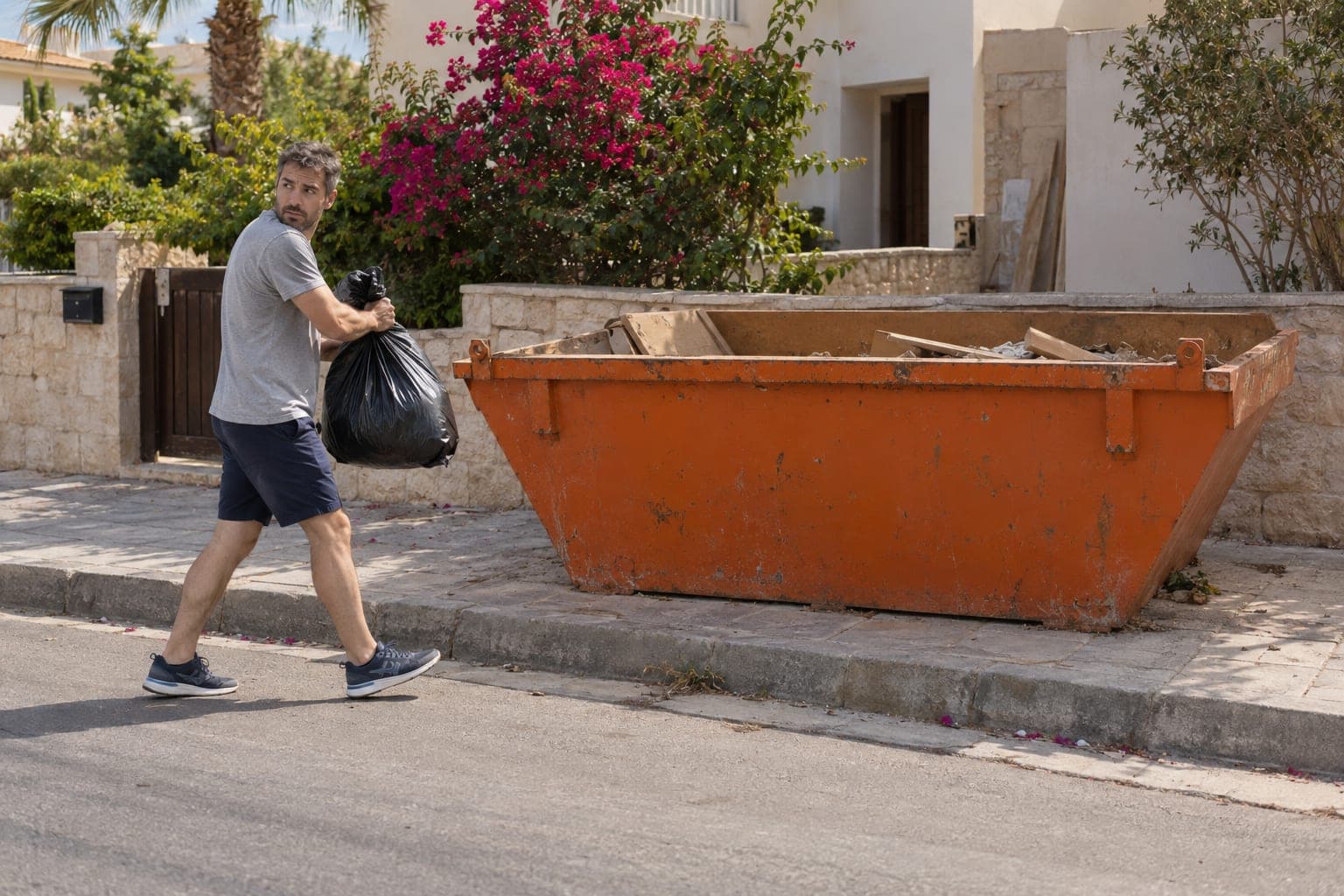
Yes, it happens all the time, and worst outside a block of flats. The driver will not sort out whose rubbish is whose: whatever ends up inside counts as yours, and the space it takes is space you paid for.
The protection is cheap: a 180–200 g/m² tarpaulin with a rope (about €35 for the pair), a laminated sign in three languages, a camera pointed at the skip, and the shortest hire you can manage. Below is how to do each one properly.
Why neighbours do it
Nobody plans to dump on you. A skip by the entrance of a block of flats looks like a communal bin, only bigger, and for half the building that is reason enough. Behind it:
- No yard, no pickup. A flat has nowhere to keep an old sofa and no way to get it to a Green Point, so it waits for an opportunity. Your skip is the opportunity.
- Anonymity. Twenty to forty flats, one entrance, and nobody sees who came down with a mattress at midnight.
- Habit. Leaving things next to the municipal bins is normal here. Limassol alone cleared almost 3,000 tonnes of bulky items off its streets in 2024–2025.
- An empty skip invites. The first night, while it is half empty, is when most of it arrives.
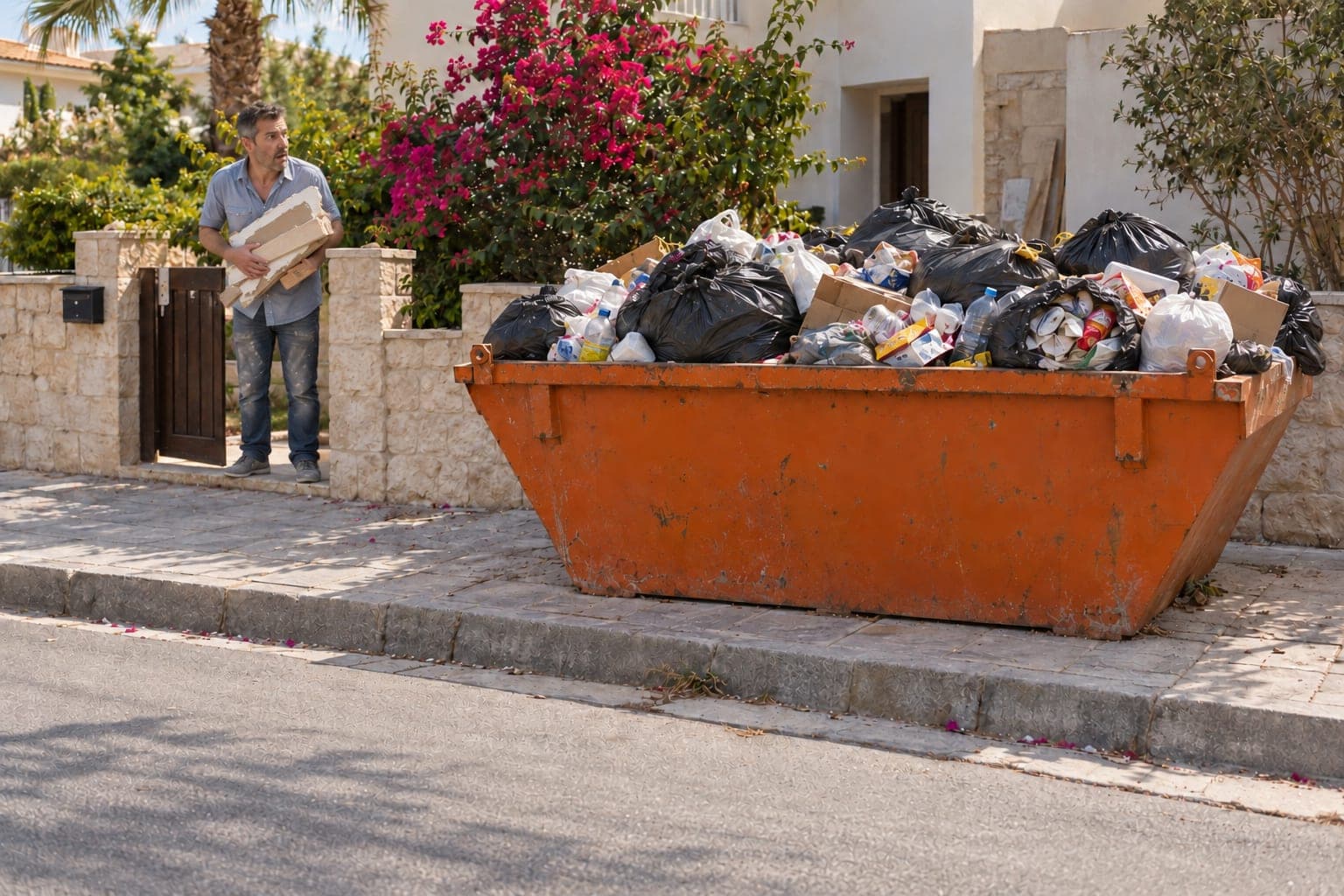
Two versions of the same problem: things go into the skip, and once it is full or covered, things get left next to it. The second is worse. The driver will not touch anything on the ground, and after collection the pile is yours.
Why the operator can't help
The hire is simple: the operator delivers and collects, you are responsible for what is inside. That is not the driver being difficult; nothing in the process separates your bags from a neighbour's:
- Space. A 6 m³ is 6 m³. Three neighbours' bags and a sofa take a quarter of it, and the quarter you then lack for your own kitchen is a second skip at full price.
- Prohibited items. Tyres, gas bottles, paint, batteries, asbestos. The tip refuses the load or charges for sorting, and the driver has no way of knowing it was not you. See what can and cannot go into a skip.
- Rubbish next to the skip is not a load. It stays on your parking space, and for the municipality it is an illegal dump outside your door.
What the operator can do: collect early if you filled up ahead of time, and bring a second skip. Lockable skips with a lid are a UK thing; nobody in Cyprus has them.
Tarpaulin and rope: the main fix
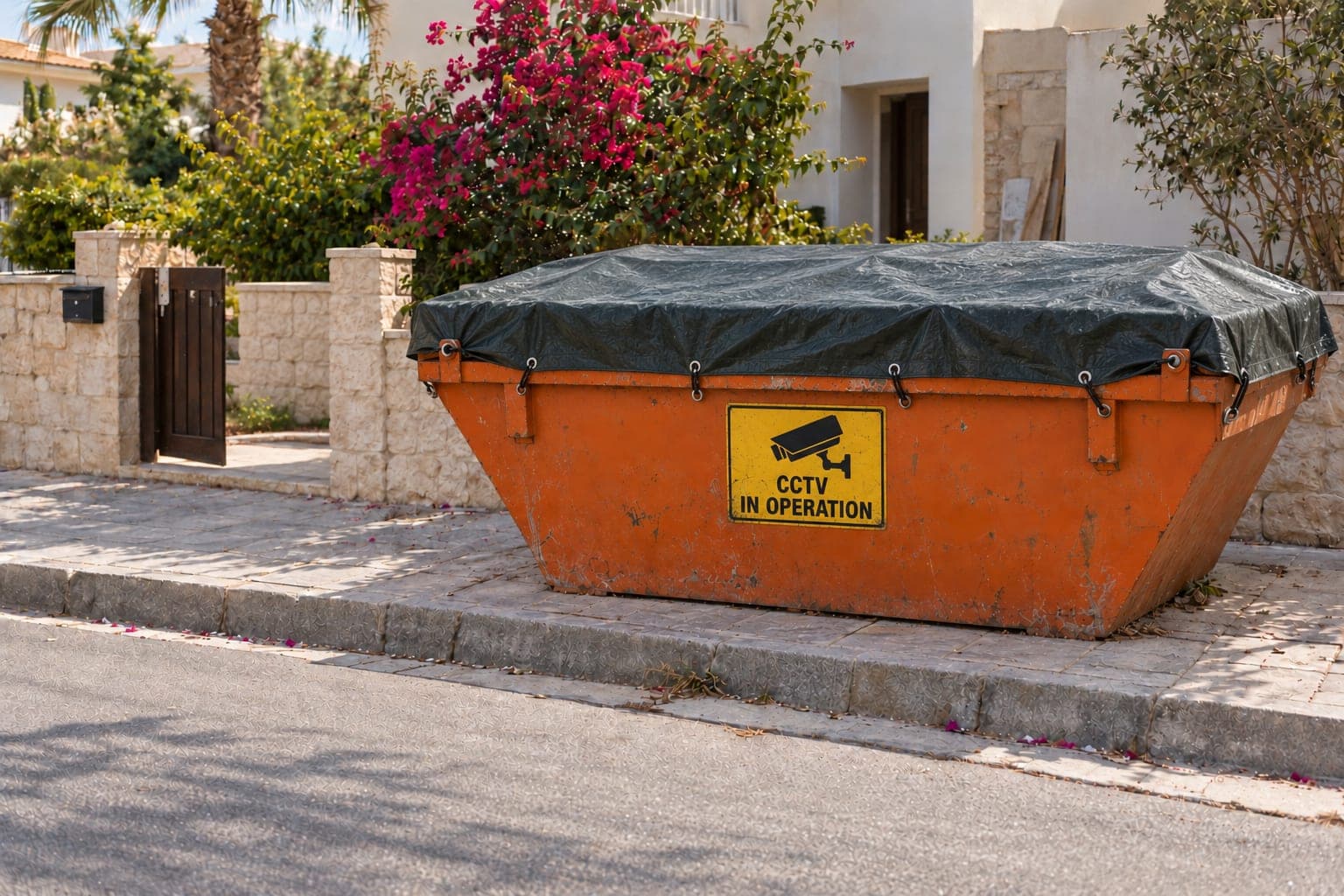
A covered skip stops looking like a communal bin. To throw something in, a neighbour has to untie and lift the cover in full view of the building, and almost nobody does. The cover also keeps rain out (wet rubble is heavier and hits the weight limit sooner) and stops light waste blowing down the street.
- Size: 4 × 6 m. Every skip has the same footprint, about 3.7 × 1.7 m; they differ in height (a 6 m³ is 0.9 m, a 9 m³ 1.3 m, a 12 m³ 1.8 m). A 4 × 6 m sheet hangs 50–100 cm below the rim of a 6 or 9 m³ and reaches the hooks on the sides. For a 12 m³ take 5 × 8 m. Bigger flaps in the wind and collects puddles.
- Weight: 180–200 g/m². Tarpaulins are sold by grams per square metre. 60 g/m² (about €12) tears on the rim the first windy night. 120 g/m² (about €16) is fine for a few calm days. 180–200 g/m² (about €30 for 4 × 6 m) survives tile edges and two weeks of sun, then has a second life in the garden.
- Eyelets. Search for 'με κρίκους' or 'with eyelets': metal rings every metre or so along the edge. No eyelets, nothing to tie to.
- Rope: 6 mm polypropylene, 20 m, €3–5. Or a set of bungee cords with hooks (€8–15): handier, but the rubber lasts one Cypriot summer. Run the rope through every second eyelet in a zigzag to the hooks and lugs on the skip. Tie one corner only and the wind rips that eyelet out, then the rest.
- No hooks within reach? A brick or a 5-litre bottle of water on each corner, taken from the skip itself.
- Where to buy. Skroutz lists dozens under 'μουσαμάς αδιάβροχος 4x6' and delivers to Cyprus; any builders' merchant has the same thing as 'heavy duty tarpaulin'.
Take the cover off before the collection window. The driver is not there to untie your tarpaulin.
The sign: laminated, three languages
The tarpaulin says 'closed'. The sign says whose it is and why. Together they work better than either alone, and a sign keeps working after the camera is gone.
- A4 or A3, big letters, Greek, English and Russian. In a Limassol or Larnaca block the neighbour may read any of the three.
- Laminate it. Paper turns to pulp after one night of dew. Any copy shop laminates an A4 for €1–2; a clear sleeve taped all the way round does in a pinch.
- Three copies: one on each long side and one on the end, on top of the tarpaulin. Cable ties through punched holes, or wide tape around the whole edge. Magnets do not hold on a rusty side.
- One more on the entrance door and by the lift the day before delivery: 'A skip for the renovation in flat 12 will stand outside from the 24th to the 27th. It is private, thank you.' That removes most of the honest mistakes.
Booking a skip outside a block of flats?
Pick the size and the day you will actually load, and we deliver across Cyprus, often the same day. Order the tarpaulin the same evening.
Book a SkipWhat to write on it
Short, and without threats:
- PRIVATE SKIP, hired by flat 12 for a renovation.
- Please put nothing inside and nothing next to it. We pay for every extra cubic metre and for other people's tyres and paint.
- Camera recording. (Only if there is one.)
- Bulky items: the municipality takes them free at the Green Point or on the bulky-waste round, tel. ...
- Illegal dumping: fines up to €8,000 under the Waste Law.
The last two lines matter. Give the neighbour a legal way out, or the sign reads as 'I don't care where your sofa goes'. And the fine is real: the 2025 amendment to the Waste Law lets an inspector fine up to €8,000 and a chief inspector up to €40,000 for illegal dumping.
A camera, a real one
UK councils measured it at fly-tipping hotspots: a visible camera with a sign cut dumping by 70–95 % within weeks. Dummy cameras they call bad practice. Once one is found out, the real ones in the area stop working too.
- An old phone on the windowsill, €0. A free motion-recording app (Alfred and the like) and a charger. Enough for a three-day hire.
- A battery camera with a solar panel, €75–90 (TP-Link Tapo C410 Kit, Eufy SoloCam S220). One screw into the balcony rail, records to a memory card, and the battery alone outlasts any hire.
- A wired outdoor Wi-Fi camera, €35–45, if there is a socket.
- A motion-sensor floodlight, €15–25. Most dumping is after dark; light takes the anonymity away.
Point it at the skip and your own space, not at the street and the neighbours' windows, and put 'camera recording' on the sign: that is both the law and the point. The footage is not for court. A neighbour shown the clip usually collects their own things.
Organise the hire so there is nothing to defend
- Book for the day you load. Clear the rooms, pile everything by the door, line up the helpers, then order. A skip three-quarters full by the first evening is not inviting.
- Fewest days. Every extra night is another chance, and after the free days each extra one is paid anyway.
- Not over a weekend. Friday night to Sunday is peak dumping, and some operators do not collect on Sundays.
- On your own ground. A yard, a driveway, the parking space under the balcony, behind a gate. On the street under a lamp post is the worst spot. Street only? Put the side against the wall, the sign and cover towards the pavement, and read the street rules first.
- Heavy first, bulky last. Branches, cardboard and film on top make the skip look full while the weight is still half.
- Photograph it every evening. The series shows what was yours and what appeared overnight, if it comes to a conversation with a neighbour or the building manager.
- Tell the building manager and let the notice go up in their name. In a block the διαχειριστής is heard where a neighbour is not.
- Share it on purpose. If a neighbour also has a pile, offer space for half the price. A legal shared skip beats an illegal one.
If it already happened
- Photograph it before touching anything. Evidence for the operator and for the municipality.
- Pull out the dangerous items: tyres, gas bottles, paint, batteries. They go to the Green Point, not in the skip. Otherwise the tip refuses the load or charges for it.
- Your own waste no longer fits? Order the collection and a second skip. That is the real cost of the neighbours' bags, and the reason the tarpaulin pays for itself.
- The pile next to the skip goes to the municipal bulky collection, not into the skip. Limassol has free Green Points at Fasoula, Kolossi, Parekklisia and Avdimou; Nicosia runs a free bulky-waste round by schedule; elsewhere call the municipality's cleaning department.
- Caught someone? Talk first. A neighbour shown the footage usually takes their things back. The municipality and the fine are the last step.
Questions and answers
- Will the driver collect a skip with someone else's rubbish in it?
- Yes. The driver takes what is inside, and who put it there makes no difference. The only things that stop a collection are prohibited items and a load far over the weight limit.
- Can I leave a neighbour's mattress in the skip?
- Yes, if you have the room. A couple of mattresses are fine; several may carry a per-mattress fee, see the mattress guide.
- Cover the skip at night or all the time?
- Whenever you are not loading. Tying it on takes two minutes, and plenty of dumping happens in daylight, when the building thinks nobody is watching.
- Which tarpaulin thickness?
- 180–200 g/m² with eyelets: 4 × 6 m for a 6 or 9 m³ skip, 5 × 8 m for a 12 m³. About €30 plus €5 of rope.
- Can a neighbour actually be fined?
- Yes. Under the 2025 amendment to the Waste Law an inspector can fine up to €8,000 for illegal dumping. In practice a photo and a calm conversation solve it faster.
Related articles
 Waste Disposal Guides
What Size Skip Do I Need in Cyprus?
The short answer: a 6 m³ for a bathroom, one room or a garden after pruning; a 9 m³ for a kitchen or a flat clearance; a 12 m³ for a villa strip-out. Sizes, prices and the traps.
 Waste Disposal Guides
What Can and Cannot Go Into a Skip in Cyprus?
A simple overview of common allowed and restricted waste types.
 Waste Disposal Guides
How Much Does Skip Hire Cost in Cyprus?
Skip hire in Cyprus costs €130 to €500. A 6 m³ is €180–€200 in the towns and €430 in Polis, delivery, collection and disposal included. What adds to it and how the online price works.