Construction Rubble in Cyprus: Where to Dispose of It Legally
Cypriots call it σκύβαλα, the word for rubbish, but after a renovation it means rubble: tiles, plaster, concrete. What the law allows, how big the fines are, what green points accept, and which skip fits in Nicosia and Larnaca.
Skyvala, mpaza, AEKK: what we are talking about
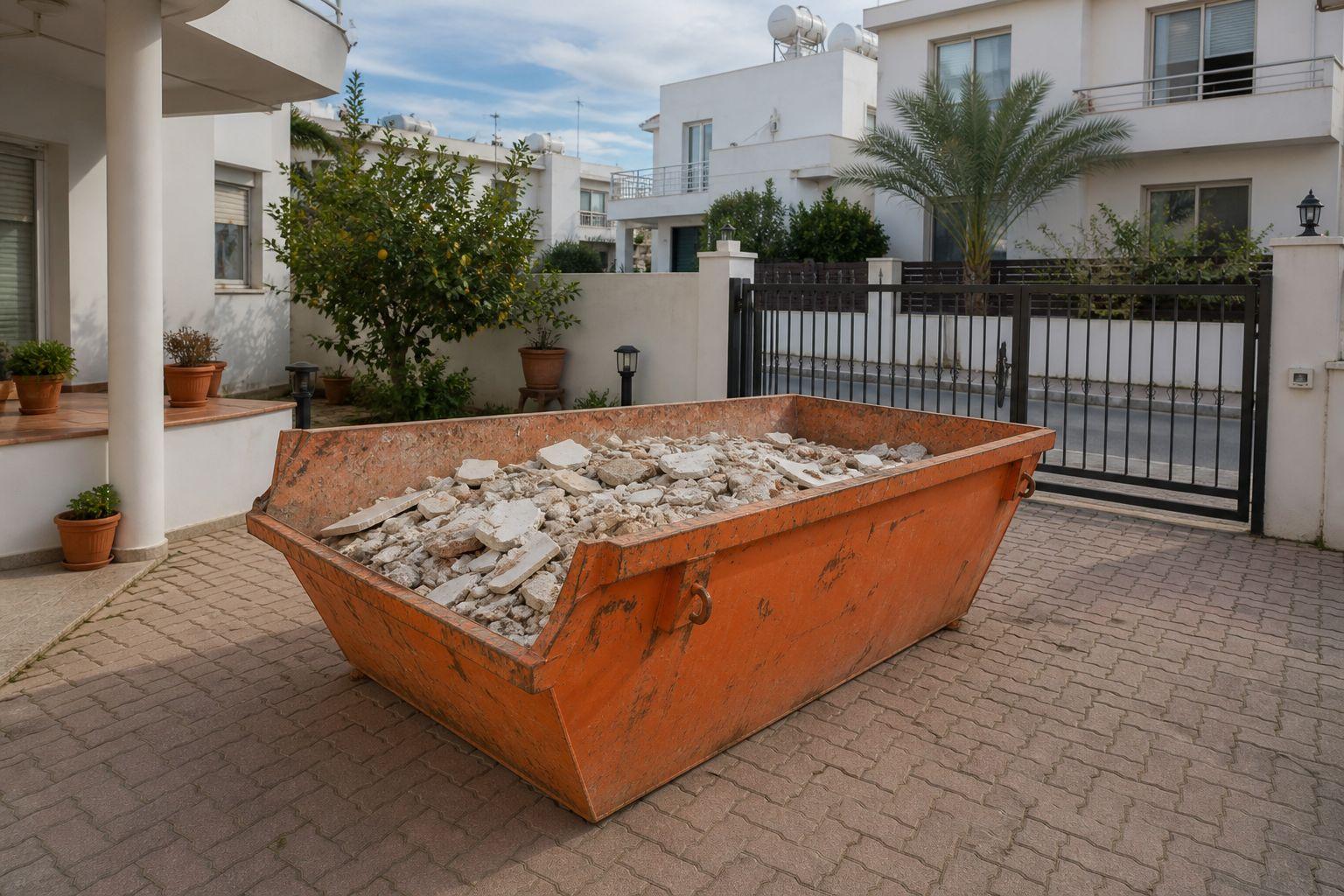
In Cyprus, σκύβαλα (skyvala) is the everyday word for rubbish. The bin lorry is the σκυβαλοφόρο, and the municipality bills you for τέλη σκυβάλων. When the builder rips out a bathroom, though, the skyvala left in the yard are rubble, μπάζα in Greek: tiles, plaster, concrete, bricks. The law calls them AEKK, waste from excavation, construction and demolition, and treats them differently from household rubbish.
The bin on your street is not for them, and the field at the edge of the village even less so. Rubble has to end up at a licensed site, and the law says so in plain words.
What counts as rubble
Anything that comes out of walls, floors and bathrooms when they are broken up:
- Floor and wall tiles, with the adhesive and screed underneath
- Plaster and pieces of partition walls
- Concrete, bricks, blocks and old paving
- Toilets, basins, bathtubs and other sanitary ware
- Marble and kitchen worktops
- A little soil and stone from digging
Plasterboard is building waste too, but not everyone takes it: the Limassol green points exclude it from their rubble category. It can go in a skip, ideally dry. Wood from old cabinets, doors and window frames can go in the same skip as the rubble.
What is not rubble and does not go in with it
- Asbestos in any form: asbestos-cement sheets (eternit), old pipes, lagging. Before asbestos is removed, the employer submits a work plan to the Department of Labour Inspection for approval and notifies it in writing at least 14 days ahead. It is a job for a specialist crew, never for a skip.
- Paint, solvents, oil, fuel and chemicals, including half-empty tins
- Batteries, tyres and gas bottles, even empty ones
- Everyday kitchen rubbish: that is for the municipal bin lorry
If any of these turns up in the load, the facility can refuse it. The full list is in what can and cannot go into a skip in Cyprus.
A house clearance (furniture, boxes, clothes) can go in a skip as well, but it is not rubble. If you are doing both at once, pick in the form what the skip mostly holds. Clean rubble is easier to recycle, while a mixed load goes through sorting first.
What the law says
The main law is the Waste Law of 2011 (Law 185(I)/2011), as amended up to 2026. Article 49 forbids anyone to place, abandon, throw or store waste on public or private land unless they hold a waste management licence themselves, or the site is controlled by a licence holder who agrees to it. The same article also forbids authorising or tolerating any of this.
In practice, the riverbed, the field and the empty plot next door are all off limits, even if "everyone dumps there". That is why it is worth knowing where your rubble goes, not only who loads it.
Anyone who collects or transports waste as a business must be entered in the Department of Environment's register of waste managers before starting (Article 33), and must hand what they carry to licensed facilities (Article 15). The Department of Environment says the same about construction waste specifically: whoever holds it hands it to a licensed company that collects, transports, recovers or disposes of it.
Building projects are also covered by the construction-waste regulations (KDP 159/2011). They put full responsibility for the rubble on the project owner, unless the owner transfers it to the contractor by contract, and require a construction-waste management plan before work starts. If you are building or renovating with a contractor, ask who has taken on the rubble in the contract.
When you book a skip with us, the load goes to a licensed facility and disposal is included in the price.
How big the fines are
Article 50 of the same law lets inspectors settle an offence out of court with a fixed payment. An inspector sets an amount in line with how serious the offence is, up to €8,000, and the chief inspector up to €40,000. If the offence is repeated or does not stop within 48 hours of the notice, the amount can be doubled. The third time, the case goes to court.
In court the penalties are much heavier: up to three years in prison or a fine of up to €500,000, or both (Article 49). As a rule, the Department of Environment also publishes its out-of-court and administrative fines together with the name of the person fined (Article 51A).
How much rubble a small renovation makes
Broken up, rubble takes far more room than it did on the wall. A tiled floor comes up with the adhesive and screed underneath, and in older houses you sometimes find a second layer of tiles under the first.
With the sizes we have today:
- One bathroom, a balcony, a partition wall: in Nicosia, the 3 m³ skip (€130). In Larnaca the smallest is the 6 m³ (€180).
- A kitchen, or new floor tiles through the whole house: 6 m³, €180 in Nicosia and €180 in Larnaca.
- Knocking down walls or renovating a whole apartment: in Nicosia, the 12 m³ (€450), which has no limit on heavy rubble. In Larnaca, two 6 m³ skips, one after the other.
Not sure? The photo estimate looks at your pile and suggests a size.
Book a skip for your rubble
Pick the town, the size and the day. Disposal at a licensed facility is included, and you see the price before you confirm.
Book a skipWith rubble, weight is what counts
A skip full of tiles and concrete weighs many times more than the same skip full of furniture. That is why on some sizes heavy rubble (concrete, bricks, tiles, soil) may fill only up to 1/5 of the skip. Today that applies to the 9 m³ in Nicosia and Larnaca. The rest of the space is for lighter things, such as wood and boxes.
In the form, pick Construction. If the size you chose has a limit on heavy waste, the form says so before you confirm. And when loading:
- Heavy pieces at the bottom, spread across the whole floor, not in a heap at one end
- Up to the rim and no higher, because an overloaded skip cannot be lifted safely
- Broken sanitary ware and glass in heavy-duty sacks, so nobody gets cut
Green points: for a little rubble, with limits
For a few bags from a small repair you do not need a skip. Green points take rubble from households only, not from contractors or businesses, and each district sets its own limits:
- Nicosia district (Nicosia EOA): clean rubble from your home, up to 100 kg per visit and up to 1 tonne in six months
- Limassol district (Limassol EOA): rubble without plasterboard, up to 200 kg or half a double-cab pickup every six months
- Larnaca district (Larnaca EOA): in May 2026 it announced that its green points no longer accept bulk construction debris from house renovations, and that each household can make up to two visits a day
The limits change. Before you load the car, check your district EOA's website or ask your municipality. The same goes for Paphos and Famagusta district, where we have not checked the limits.
A skip on the street: do you need a permit?
On your own driveway or plot you need nothing. On the street, the municipality has the say.
In Nicosia, a placement permit from the municipality is needed only on the main central avenues. On ordinary residential streets the skip goes down with no paperwork, and if your address is on one of the avenues, we tell you before delivery.
For Limassol we have a separate guide: skip permits on Limassol streets. For other towns, and for what the law says about public roads, see a skip on a public road in Cyprus.
Rubble in Nicosia
In Nicosia we have four sizes: 3 m³ (€130), 6 m³ (€180), 9 m³ (€230) and 12 m³ (€450). The price is the same for rubble, garden waste, furniture or general waste, and it covers delivery, collection and disposal at a licensed facility.
For rubble, the 3 m³ mini skip fits in a parking space and is enough for one bathroom. The 6 m³ stays 21 days at no extra charge, which suits jobs where the builders come and go. The 9 m³ takes heavy rubble only up to 1/5, so for a lot of concrete take the 12 m³.
For a little rubble from your home there are the district green points, up to 100 kg per visit. For everything else: skip hire in Nicosia. The prices in detail are in how much a skip costs in Nicosia.
Rubble in Larnaca
In Larnaca we have two sizes: 6 m³ (€180) and 9 m³ (€230), both with 21 days included. For rubble, take the 6 m³. The 9 m³ takes heavy rubble only up to 1/5 and suits renovations with plenty of light waste (cabinets, doors, boxes) and few tiles.
Since May 2026 the district's green points no longer take bulk debris from renovations, so for a bathroom or a kitchen you need a skip.
Book on the skip hire in Larnaca page. The prices in detail are in how much a skip costs in Larnaca.
Questions and answers
- Can I put rubble in the municipal bin?
- No. The bin is for household rubbish. A little rubble from your own home can go to the district green point, if it accepts it. For more, you need a skip.
- What is the fine for dumping rubble illegally?
- Out of court, up to €8,000 from an inspector and up to €40,000 from the chief inspector, depending on how serious it is (Article 50 of the Waste Law). If the case goes to court, a fine of up to €500,000 or up to three years in prison, or both.
- My builder says he will take the rubble away himself. Is that fine?
- It can be. Ask him where it goes. Anyone who transports waste as a business must be entered in the Department of Environment's register of waste managers and must deliver it to a licensed facility.
- How much rubble fits in a skip?
- As much as reaches the rim, spread out. On some sizes heavy rubble may fill only up to 1/5; today that is the 9 m³ in Nicosia and Larnaca. If you pick Construction, the form tells you before you confirm.
- What do I do if I find asbestos during the renovation?
- Stop work on that spot and do not break it. Asbestos removal needs a work plan approved by the Department of Labour Inspection, and asbestos does not go in a skip.
Related articles
 Waste Disposal Guides
What Size Skip Do I Need in Cyprus?
The short answer: a 6 m³ for a bathroom, one room or a garden after pruning; a 9 m³ for a kitchen or a flat clearance; a 12 m³ for a villa strip-out. Sizes, prices and the traps.
 Waste Disposal Guides
What Can and Cannot Go Into a Skip in Cyprus?
A simple overview of common allowed and restricted waste types.
 Waste Disposal Guides
How Much Does Skip Hire Cost in Cyprus?
Skip hire in Cyprus costs €130 to €500. A 6 m³ is €180–€200 in the towns and €430 in Polis, delivery, collection and disposal included. What adds to it and how the online price works.